
Play-Based Inquiry: How We Foster Curiosity at Mandarin English bilingual kindergarten in HCMC
Imagine a classroom without traditional "desks" and "lectures." Imagine a space where children lead, ask "Why?" and "How?" and the teacher acts as a guide, not just an instructor. At Vietnam Mandarin Kindergarten (VMK), this isn't an imaginary scenario—it’s our daily reality, defined by our unique approach to play-based inquiry-based learning.
Our kindergarten in Hanoi uses this progressive model to transform learning from a passive absorption of facts into an active, hands-on journey of discovery.
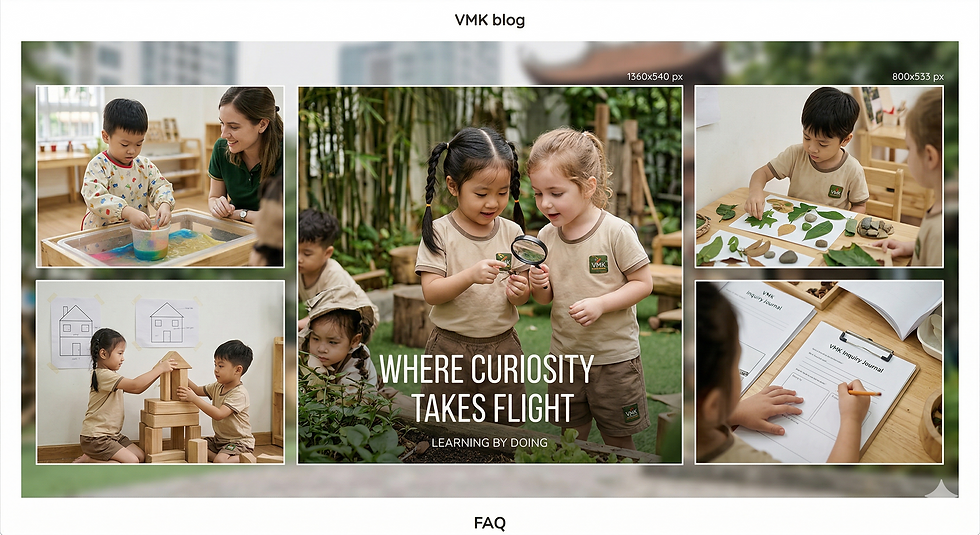
What is Play-Based Inquiry?
It’s the synthesis of two powerful methods. We take the natural language of childhood—play—and combine it with a structured approach to inquiry, or the process of investigating questions.
In other words, at VMK, when children play, they are also researching, testing hypotheses, and drawing conclusions. Play is the engine, and inquiry is the destination. A block center isn't just a place to stack shapes; it’s an engineering lab to test gravity and balance.
Why is Rote Memorization Not Enough?
In the 21st century, simply recalling information is no longer a path to success. The world changes rapidly. The skills children will need in the future—critical thinking, collaboration, and adaptability—cannot be learned from a textbook or a flashcard.
By focusing on inquiry-based learning, our kindergarten empowers Hanoi children to think for themselves. When a student asks "Why do birds have different feathers?", we don't just give them a definition. We find bird feathers, look at them under a magnifying glass, and perhaps visit a local aviary.

Nurturing the Whole Child
This child-centered education is crucial for developing the "Whole Child," balancing cognitive development with critical social and physical skills.
Cognitive and Academic Growth
Critical Thinking: Children solve real problems they encounter in their play (e.g., "How can we make this bridge more stable?").
Early Literacy & Math: Language and numbers are integrated into meaningful activities, not isolated drills.
Physical Development and Wellbeing
Fine Motor Skills: Activities like pouring sand, working with loose parts, and creative art projects build small muscle strength.
Gross Motor Skills: Our outdoor spaces encourage running, climbing, and coordination, essential for a healthy body and mind.
Social and Emotional Learning (SEL)
Collaboration: Inquiry projects are often communal, teaching empathy, sharing, and communication.
Resilience: A play-based curriculum allows children to experiment, fail safely, and try again, building an essential growth mindset.
Conclusion: A HCMC Kindergarten Built for Future Leaders
The curiosity your child shows today is the foundation for the innovation of tomorrow. By choosing inquiry-based learning at a kindergarten in Hanoi like VMK, you are investing in a model that doesn't just prepare them for a primary school desk—it prepares them for life's challenges, turning them into lifelong, joyful learners.
FAQ
Q: Is there structure in a play-based classroom?
A: Absolutely. Our teachers carefully design environments with intentional "provocations"—materials and questions that guide and deepen children’s natural inquiry.
Q: How can play help my child develop social and emotional skills?
A: Play is the context where children practice sharing, taking turns, and solving social conflicts. Our SEL-focused curriculum provides the language to navigate these interactions successfully.


